-
Avviso
La biblioteca e l’archivio sono aperti al pubblico su prenotazione in osservanza delle norme anticovid.
Contatti:
E-mail: centrostudigm@gmail.com
Tel: +39 347 1095386
Indirizzo: via Tevere, 20 – 00198 Roma
Orari: lun – ven dalle 09.00 – 15.00Classifica Articoli e Pagine
- Un altro meglio abbandonato che ... "valorizzato" ...
- FANTASMI "DI QUALITA'" ... IL POCO CREDIBILE PASTICCIO DI PIAZZA DEI NAVIGATORI ...
- Ceci n’est pas une eglise …
- CAPANNA ON LINE ...
- "DEDALO" ... LA LIBRERIA DELL'ARCHITETTO ...
- Gian Carlo Leoncilli Massi … e la Leggenda del comporre …
- Giorgio Muratore
- Giovanni Michelucci a Tor San Lorenzo (reprise) ...
- Kounellis … socchiude, ad arte, l’orto dei monaci …
- SULLA SPIAGGIA ... COME LI REGAZZINI ...
Commenti recenti
- Lazio su AUGURI DARIO!
- Mauro Risi su AUTOBIOGRAFIE SCIENTIFICHE. Marco Petreschi “L’arpa Birmana”. 22 giugno 2023.
- Franco ansrlmuvvi su Un ricordo per Paolo Portoghesi di Franco Purini
- Claudio De Santis -architetto su Un ricordo per Paolo Portoghesi di Franco Purini
-
Articoli recenti
- Venerdì 17 aprile dalle 17:30 vi aspettiamo per un incontro di studi su VENTURINO VENTURA, al Centro Studi GM.
- Al Centro Studi GM. PRESENTAZIONE del volume “THE OTHER ROME” curato da Jean-Francois Lejeune 13 febbraio 2026.
- Al Centro Studi GM. PRESENTAZIONE del volume “THE OTHER ROME” curato da Jean-Francois Lejeune
- Venerdì 13 febbraio dalle 17:30 vi aspettiamo per LA PRESENTAZIONE del volume “THE OTHER ROME” curato da Jean-Francois Lejeune, al Centro Studi GM.
- FRANZ PRATI CI HA LASCIATI
Archivi


 Centro Studi Giorgio Muratore
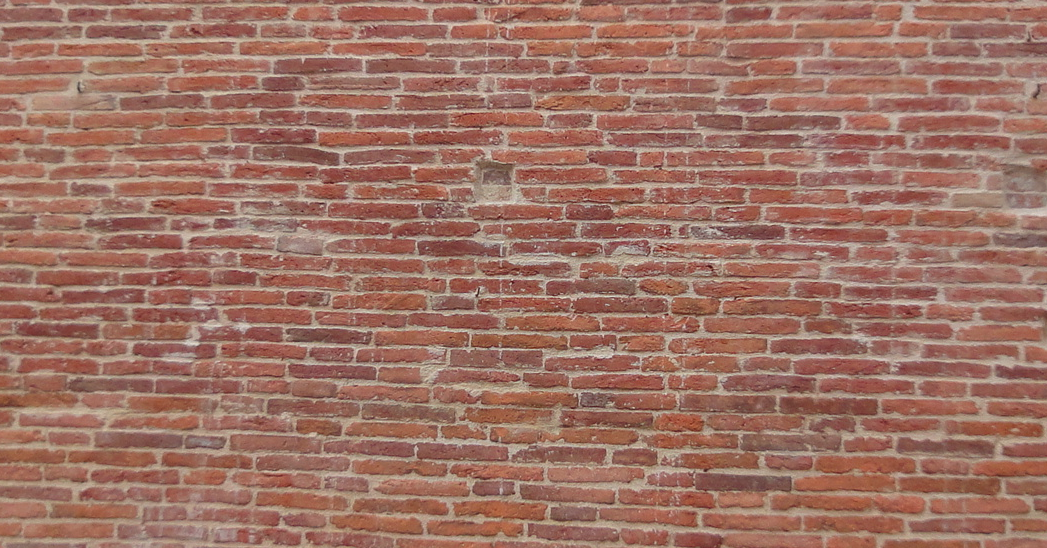
Questi “quattro mattoni”, imperfetti per impasto, cottura e calibro, messi in opera in maniera non casuale – i due mattoni curvi murati simmetricamente, un po’ decorazione e un po’ risoluzione di un problema -, questa pelle ruvida e grinzosa che porterà con dignità gli acciacchi del tempo, per il fatto che è fuori dal tempo, come è nelle intenzioni dell’architettura, è una lezione di vitalità, di modernità e di giovinezza per le levigate, lucenti e caduche pelli metalliche o vitree, specchio delle vacua contemporaneità, intimamente legate al tempo e perciò stesso vecchie dopo un giorno di vita.
C’è sapienza in questo muro senza nome, oltre che lavoro e fatica, ed è infinitamente umano. E non è unico. Ce ne sono tanti in giro.
Saluti
Pietro
Scusatemi se riciclo questo post in inglese da 2007, ma è pertinente qui.
I have been meaning to write an article on how brick walls can be used to teach the principles of good design, but never got around to it. Here are some quick points.
1. The scaling hierarchy must include both brick and the width of the grout/mortar as consecutive scales; that is, the latter should be substantial and thick, up to 1/3 of the brick’s width. Modernist bonded bricks with wafer-thin grout destroy the hierarchical scaling effect.
2. Alternation is a basic design principle (see Christopher Alexander’s “The Nature of Order”). Great walls alternate their bricks horizontally: full size/half size, and arrange them so the pattern alternates vertically as well.
3. Symmetry breaking. Using slight differences of color and shape prevents a translational symmetry such as possessed by identical units. The wall then becomes ONE unit on the larger scale, since every component is distinct. Informationally, we see the entire wall as a coherent whole, instead of merely repeating a single identical brick. Put in computer terms, one can compress a modernist brick wall into just a few bytes of information: whereas an old brick wall requires a large file for representation. Not as large as a completely RANDOM design; the broken symmetry is what makes it connect to the human perceptual system.
4. Louis Sullivan had a trick of introducing randomness in his brick walls, probably to achieve this informational coherence. Pity he never described in detail exactly what he did, but one can see it in his late banks.
I hope these points are helpful. In conclusion, we respond to the older brick walls because they embody these and other mathematical properties, and such properties (and thus responses) are universal with all human beings.
Best wishes
Nikos
Spiacente davvero, leggo solo il francese.
Bella cosa essere d’accordo.Un mattone non è mai solo un mattone, aspira ad essere qualcosaltro…ecc